Insuring Your Sealcoating Equipment: Tanks, Spray Systems, and Crack Fill Machines
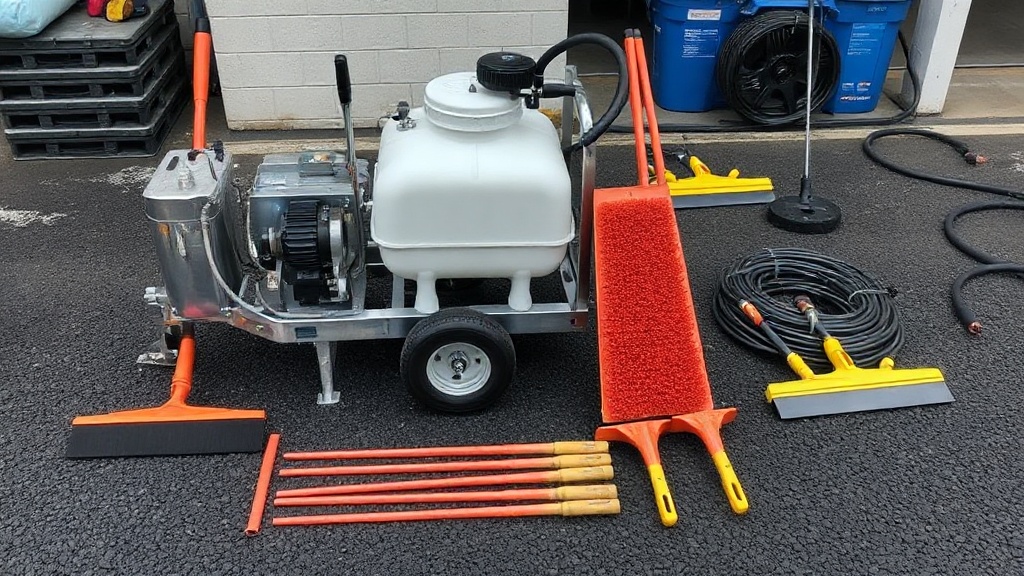
For most sealcoating contractors, the equipment is the business. A quality sealcoating tank and spray system can run $15,000 to $25,000. A commercial crack fill machine adds another $4,000 to $8,000. A line striper brings the total higher still. When that equipment gets stolen, damaged, or destroyed, you're not just down money — you're out of production.
The right insurance covers these situations. The wrong policy — or a policy with the wrong terms — pays a fraction of what you need, leaves you scrambling to replace equipment out of pocket, or denies the claim entirely.
What Tools and Equipment Coverage Actually Is
Tools and equipment insurance (sometimes called "contractors' equipment" or "equipment floater") is a property coverage designed specifically for contractor equipment. It covers physical damage to your sealcoating equipment from theft, vandalism, fire, and accidental damage — not just at your shop, but at job sites and in storage.
This is distinct from commercial auto insurance. Your commercial auto policy covers the truck. It does not cover the spray tank bolted in the bed or the crack fill machine chained in the trailer. This is one of the most common coverage misunderstandings in the trades, and it creates real gaps at claim time.
Replacement Cost vs. Actual Cash Value — This Matters Enormously
When you file a tools and equipment claim, the payout amount depends on one critical policy choice: replacement cost (RC) versus actual cash value (ACV).
Replacement cost pays what it actually costs to replace the equipment with a comparable new unit today.
Actual cash value pays replacement cost minus depreciation — which means a sealcoating tank that cost $18,000 when you bought it four years ago might be valued at $9,000 or $10,000 at claim time, depending on the depreciation schedule.
For a sealcoating operation that depends on its spray system to generate revenue, ACV is a trap. A $9,000 claim payout won't replace an $18,000 tank. You're forced to either take on debt, compromise on replacement quality, or eat the difference.
Always insure your sealcoating equipment at replacement cost. The premium difference between RC and ACV is typically modest. The difference at claim time is not.
What to Schedule and What to Blanket
For your highest-value equipment — your primary sealcoating tank and spray system — scheduled coverage is the right approach. You list the item, describe it, and assign it a specific insured value. If that tank is stolen or totaled, the claim is based on that scheduled value.
For smaller tools — spray wands, hand tools, extension hoses, safety cones — a blanket limit is more practical. You set a total blanket value (say, $5,000 or $10,000) for all unscheduled tools, and claims are paid from that pool up to the blanket limit.
A well-structured tools policy typically combines scheduled coverage for high-value items with a blanket limit for everything else.
Job Site Theft — The Risk Nobody Wants to Think About
Sealcoating equipment on a job site is exposed. Crack fill machines left at a large parking lot job overnight, spray wands stored in an unlocked trailer, small equipment left at a commercial lot between visits — these are real theft scenarios.
Your tools and equipment policy should cover theft from job sites, not just theft from your shop or yard. Some policies limit coverage to "scheduled locations" (i.e., your business address) and exclude job sites entirely. Others require that equipment be locked and secured to qualify for theft coverage.
Read the policy terms. If job site theft isn't covered, you need either a different policy or an inland marine endorsement that specifically covers equipment at temporary locations.
The Inland Marine Layer
For equipment that travels — tanks on a trailer, crack fill machines being hauled to a job, line stripers going to a commercial account across town — inland marine insurance adds coverage for equipment in transit and at remote locations.
Think of it as the bridge between your commercial auto policy (which ends where the vehicle ends) and your tools and equipment policy (which covers your shop and listed locations). For sealcoating contractors who are constantly loading and unloading equipment, inland marine is often the right complement to a tools policy.
What Deductibles Make Sense?
Most tools and equipment policies offer deductibles ranging from $250 to $2,500. Higher deductibles lower your premium; lower deductibles mean less out-of-pocket at claim time.
For equipment as expensive as a sealcoating spray system, the right deductible is the amount you can genuinely absorb without stress. If a $1,000 deductible on a $20,000 tank claim means the policy pays $19,000, that's probably worth the small premium reduction. If a $2,500 deductible would strain your cash flow during the repair or replacement period, it's not worth it.
Don't choose deductibles based on premium alone. Choose them based on your actual financial capacity to handle a partial loss.
Getting Your Equipment Inventory Right
A tools and equipment claim is paid based on what's in the policy. If your spray system isn't listed, it's not covered. If it's listed at half its value, the claim pays half.
Take the time to do an equipment inventory. List every item of value: your sealcoating tanks and spray systems (with make, model, and purchase price), crack fill equipment, line stripers, generators, power tools, hand tools worth noting. Give the list to your agent and make sure it's reflected in the policy.
Update the list every year — especially after equipment purchases. An equipment inventory that's three years out of date is an invitation to a coverage shortfall at claim time.
Need this coverage for your sealcoating business?
Get a real quote in about 15 minutes — we shop A-rated specialty contractor markets.